Wind Energy Basics

Wind Energy Basics

Basic information on wind energy and wind power technology, resources, and issues of concern.

Wind Energy and Wind Power

Wind is a form of solar energy. Winds are caused by the uneven heating of the atmosphere by the sun, the irregularities of the earth's surface, and rotation of the earth. Wind flow patterns are modified by the earth's terrain, bodies of water, and vegetative cover. This wind flow, or motion energy, when "harvested" by modern wind turbines, can be used to generate electricity.

How Wind Power Is Generated

The terms "wind energy" or "wind power" describe the process by which the wind is used to generate mechanical power or electricity. Wind turbines convert the kinetic energy in the wind into mechanical power. This mechanical power can be used for specific tasks (such as grinding grain or pumping water) or a generator can convert this mechanical power into electricity to power homes, businesses, schools, and the like.

Wind Turbines

Wind turbines, like aircraft propeller blades, turn in the moving air and power an electric generator that supplies an electric current. Simply stated, a wind turbine is the opposite of a fan. Instead of using electricity to make wind, like a fan, wind turbines use wind to make electricity. The wind turns the blades, which spin a shaft, which connects to a generator and makes electricity.

Wind Turbine Types

Modern wind turbines fall into two basic groups; the horizontal-axis variety, like the traditional farm windmills used for pumping water, and the vertical-axis design, like the eggbeater-style Darrieus model, named after its French inventor. Most large modern wind turbines are horizontal-axis turbines.

Turbine Components

Horizontal turbine components include:
  • blade or rotor, which converts the energy in the wind to rotational shaft energy;
  • a drive train, usually including a gearbox and a generator;
  • a tower that supports the rotor and drive train; and
  • other equipment, including controls, electrical cables, ground support equipment, and interconnection equipment.
Wind turbine diagram - click for enlarged image.

Wind turbine diagram

Turbine Configurations

Wind turbines are often grouped together into a single wind power plant, also known as a wind farm, and generate bulk electrical power. Electricity from these turbines is fed into a utility grid and distributed to customers, just as with conventional power plants.
See Wind Energy Photos page for wind farm photographs.

Wind Turbine Size and Power Ratings

Wind turbines are available in a variety of sizes, and therefore power ratings. The largest machine has blades that span more than the length of a football field, stands 20 building stories high, and produces enough electricity to power 1,400 homes. A small home-sized wind machine has rotors between 8 and 25 feet in diameter and stands upwards of 30 feet and can supply the power needs of an all-electric home or small business. Utility-scale turbines range in size from 50 to 750 kilowatts. Single small turbines, below 50 kilowatts, are used for homes, telecommunications dishes, or water pumping.
See Wind Energy Photos page for wind turbine photographs.

Wind Energy Resources in the United States

Wind energy is very abundant in many parts of the United States. Wind resources are characterized by wind-power density classes, ranging from class 1 (the lowest) to class 7 (the highest). Good wind resources (e.g., class 3 and above, which have an average annual wind speed of at least 13 miles per hour) are found in many locations (see United States Wind Energy Resource Map). Wind speed is a critical feature of wind resources, because the energy in wind is proportional to the cube of the wind speed. In other words, a stronger wind means a lot more power.

Advantages and Disadvantages of Wind-Generated Electricity

A Renewable Non-Polluting Resource

Wind energy is a free, renewable resource, so no matter how much is used today, there will still be the same supply in the future. Wind energy is also a source of clean, non-polluting, electricity. Unlike conventional power plants, wind plants emit no air pollutants or greenhouse gases. According to the U.S. Department of Energy, in 1990, California's wind power plants offset the emission of more than 2.5 billion pounds of carbon dioxide, and 15 million pounds of other pollutants that would have otherwise been produced. It would take a forest of 90 million to 175 million trees to provide the same air quality.

Cost Issues

Even though the cost of wind power has decreased dramatically in the past 10 years, the technology requires a higher initial investment than fossil-fueled generators. Roughly 80% of the cost is the machinery, with the balance being site preparation and installation. If wind generating systems are compared with fossil-fueled systems on a "life-cycle" cost basis (counting fuel and operating expenses for the life of the generator), however, wind costs are much more competitive with other generating technologies because there is no fuel to purchase and minimal operating expenses.

Environmental Concerns

Although wind power plants have relatively little impact on the environment compared to fossil fuel power plants, there is some concern over the noise produced by the rotor blades, aesthetic (visual) impacts, and birds and bats having been killed (avian/bat mortality) by flying into the rotors. Most of these problems have been resolved or greatly reduced through technological development or by properly siting wind plants.

Supply and Transport Issues

The major challenge to using wind as a source of power is that it is intermittent and does not always blow when electricity is needed. Wind cannot be stored (although wind-generated electricity can be stored, if batteries are used), and not all winds can be harnessed to meet the timing of electricity demands. Further, good wind sites are often located in remote locations far from areas of electric power demand (such as cities). Finally, wind resource development may compete with other uses for the land, and those alternative uses may be more highly valued than electricity generation. However, wind turbines can be located on land that is also used for grazing or even farming.
Read more

Environmental impacts

What are the environmental impacts? Wind plants produce no air pollution. They use no water, and there is no need to tear up the land to extract the wind resource that produces wind power. Nonetheless, there may be environmental problems associated with some wind plants.
Wind power generates three categories of environmental impacts: visual impacts; noise pollution; wildlife impacts. These impacts can vary immensely from site to site.

Because wind farms are comprised of large numbers of turbines each mounted atop tall towers in rural areas, they can often be seen for a long distance. Whether this visual impact is good or bad will vary from location to location. Some find wind turbines to be enduring symbols of self-sufficiency. Others see them as stark intrusions in the "natural" landscape.

Wind turbines, particularly older designs, emit noise that can be heard in the vicinity of the wind farms. The level of noise produced by one wind turbine is equivalent to that of your washing machine. The frequency and volume of this noise can be controlled but not eliminated by wind turbine design.

The most controversial significant negative environmental impact of early wind turbines is the impact on bird populations, an issue largely resolved by new turbine designs.

In the early 1980s, three major wind farms were built in passes in California. At the Altamont Pass site, deaths of birds, particularly raptors, prompted a number of studies that subsequently influenced both the design of newer wind turbines and the siting of wind farms. It was discovered that raptors perch atop the wind generators for a better view while hunting, and upon rare occasion get caught in the spinning blades when the wind begins to blow. Current wind turbine technology offers solid tubular towers to prevent birds from perching on them. Turbine blades also rotate more slowly than those of earlier designs, reducing potential for collisions with birds.
If wind power plants are sited in regions screened for sensitive local bird populations, the environmental footprint of wind-generated electricity is quite small when compared to the wildlife and ecosystem impacts of fossil fuel mining and fuel combustion.
The manufacture of wind generation technology creates some air emissions.
Read more

Wind plants

Electricity from:
Wind


Wind power is the world's fastest growing electricity generation technology. Wind is a renewable resource because it is inexhaustible. It is a result of the sun shining unevenly on the earth. The corresponding daily and seasonal changes in temperature consistently generate wind, producing a fuel source that can never be depleted.
State-of-the-art wind power plants use large spinning blades to capture the kinetic energy in moving wind, which then is transferred to rotors that produce electricity. At the best wind fuel sites, wind plants today are nearly competitive with the conventional natural gas-fired combined-cycle plants -- even when natural gas prices have recently been at historically low levels. Regions where average wind speeds exceed 12 miles per hour are currently the best wind power plant sites.
Current costs of wind-generated electricity at prime sites approach the costs of a new coal-fired power plant. Wind power is the lowest-cost renewable energy technology available on the market today. According to the Department of Energy, the costs of wind power are projected to continue to fall and may rank the cheapest electricity source of all options by 2020.

What are the environmental impacts?
Wind plants produce no air pollution. They use no water, and there is no need to tear up the land to extract the wind resource that produces wind power. Nonetheless, there may be environmental problems associated with some wind plants.
Wind power generates three categories of environmental impacts: visual impacts; noise pollution; wildlife impacts. These impacts can vary immensely from site to site.

Because wind farms are comprised of large numbers of turbines each mounted atop tall towers in rural areas, they can often be seen for a long distance. Whether this visual impact is good or bad will vary from location to location. Some find wind turbines to be enduring symbols of self-sufficiency. Others see them as stark intrusions in the "natural" landscape.

Wind turbines, particularly older designs, emit noise that can be heard in the vicinity of the wind farms. The level of noise produced by one wind turbine is equivalent to that of your washing machine. The frequency and volume of this noise can be controlled but not eliminated by wind turbine design.

The most controversial significant negative environmental impact of early wind turbines is the impact on bird populations, an issue largely resolved by new turbine designs.

In the early 1980s, three major wind farms were built in passes in California. At the Altamont Pass site, deaths of birds, particularly raptors, prompted a number of studies that subsequently influenced both the design of newer wind turbines and the siting of wind farms. It was discovered that raptors perch atop the wind generators for a better view while hunting, and upon rare occasion get caught in the spinning blades when the wind begins to blow. Current wind turbine technology offers solid tubular towers to prevent birds from perching on them. Turbine blades also rotate more slowly than those of earlier designs, reducing potential for collisions with birds.
If wind power plants are sited in regions screened for sensitive local bird populations, the environmental footprint of wind-generated electricity is quite small when compared to the wildlife and ecosystem impacts of fossil fuel mining and fuel combustion.
The manufacture of wind generation technology creates some air emissions.
Read more
Wind-Electric System Types
Off-Grid Wind-Electric Systems
Off-grid wind-electric systems are battery based. People generally choose these systems because their home or other energy use is not connected to the grid, and connection would be expensive. Others prefer the independence of off-grid systems, or live where utilities and governments make it difficult to tie a renewable energy system to the grid.
Off-grid systems are limited in capacity by the size of the generating sources (wind turbine, solar-electric array, fuel-fired generator, etc.), the resources available, and the battery bank size. Off-grid homeowners have to learn to live within the limitations of their system capacity.
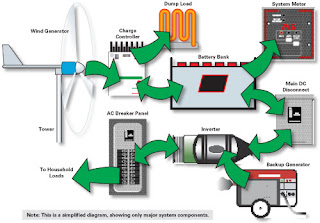
The following illustration includes the primary components of any off-grid wind-electric system with battery backup. See our Wind-Electric System Components section for an introduction to the function(s) of each component.

See also the following Home Power feature articles:

Watts in the Wind

--------------------------------------------------------------------------------
Grid-Tied Wind-Electric System with Battery Backup
Connecting a wind-electric system to the utility grid with battery backup gives you the best of both worlds. You have the unlimited capacity of the grid at your disposal, and you can send your surplus wind energy to the grid. When the grid is down, you can still use your system, within the limitations of the battery bank and turbine. Wind-electric systems can be a much better match for utility backup than solar-electric systems, since many grid outages are caused by high winds. The drawback is that this is the most expensive type of wind-electric system you can install.
The following illustration includes the primary components of any grid-tied wind-electric system with battery backup. See our Wind-Electric System Components section for an introduction to the function(s) of each component.

See also the following Home Power feature articles:
The First Small Wind System in Lassen County

Batteryless Grid-Tied Wind-Electric System
Connecting to the grid without batteries is the most cost-effective and environmentally friendly way to go. You eliminate batteries, which are costly, require maintenance, and carry a significant efficiency penalty. The only drawback of batteryless systems is that when the grid is down, your system shuts down. But in most grid-serviced areas, utility outages are only a few hours a year—a small inconvenience to endure for the efficiency, environmental friendliness, and thriftiness of these systems.
Batteryless grid-tie systems may see increased performance (sometimes dramatically) from the wind turbine compared to battery-based systems. This is because the inverter´s electronics can match the wind´s load more exactly, running the turbine at optimum speed, and extracting the maximum energy.
The following illustration includes the primary components of any batteryless grid-tied wind-electric system. See our Wind-Electric System Components section for an introduction to the function(s) of each component.

See also the following Home Power feature articles:
At Last....Simple Wind Grid-Tie
Betting the Farm—Wind Electricity Pays Off
Farming the Wind

--------------------------------------------------------------------------------
Direct-Drive Batteryless Wind-Electric System
These are the least common wind-electric systems, typically used for water pumping. A turbine is matched to a pump, often through an electronic controller. When the wind blows, water is pumped to an elevated tank, a stock-watering tank, or directly to the land to irrigate. These systems can be simple and cost effective in the right situation. Direct-drive systems are also used for heating, which can be a good match, since it´s normally colder when it´s windy. But heating is a big load, so large turbines are needed.
The following illustration includes the primary components of any batteryless grid-tied wind-electric system. See our Wind-Electric System Components section for an introduction to the function(s) of each component.


Wind-Electric System Components
Understanding the basic components of an RE system and how they function is not an overwhelming task. Here are some brief descriptions of the common equipment used in grid-intertied and off-grid wind-electric systems. Systems vary—not all equipment is necessary for every system type.
Read more

about windmills

Wind Electricity Basics
Small wind-electric systems can provide electricity on remote, off-grid sites, or right in town connected to the utility grid. Although wind systems require more maintenance and need more attention than solar-electric or microhydro-electric systems, if you invest up front in good equipment, design, and installation, wind-electric systems can make economic and environmental sense. They also bring a great deal of satisfaction—there´s nothing quite like watching your wind generator convert a summer breeze or a winter storm into electrical energy.

How It Works
Boiled down to its simplest principles, a wind generator´s rotating blades convert the wind´s kinetic energy into rotational momentum in a shaft. The rotating shaft turns an alternator, which makes electricity. This electricity is transmitted through wiring down the tower to its end use.
The blades use engineered airfoils, matched to the alternator, that capture the wind´s energy. Most modern wind generators use three blades, the best compromise between the highest efficiency possible (one blade) and the balance that comes with multiple blades. Together, the blades and the hub they are attached to are termed the rotor, which is the collector of the system, intercepting winds that pass by. Most turbines on the market today are upwind machines—their blades are on the windward side of the tower. A few downwind machines are available, but neither configuration has a clear performance advantage over the other.
In most small-scale designs, the rotor is connected directly to the shaft of a permanent magnet alternator, which creates wild, three-phase AC. Wild, three-phase electricity means that the voltage and frequency vary continuously with the wind speed. They are not fixed like the 60 Hz, 120 VAC electricity coming out of common household outlets. The wild output is rectified to DC to either charge batteries or feed a grid-synchronous inverter. In most designs (up to 15 KW in peak capacity), the rotor is usually connected directly to the alternator, which eliminates the additional maintenance of gears. In systems 20 KW and larger, as well as some smaller wind systems (like the Endurance, Tulipo, or Aircon), a gearbox is used to increase alternator speed from a slower turning rotor.
The blades must turn to face the wind, so a yaw bearing is needed, allowing the wind turbine to track the winds as they shift direction. The tail directs the rotor into the wind. Some sort of governing system limits the rotor rpm as well as generator output to protect the turbine from high winds. A shutdown mechanism is also useful to stop the machine when necessary, such as during an extreme storm, when you do not need the energy, or when you want to service the system.

How Wind Turbines are Rated
Wind turbine rating is a tricky affair. While solar-electric module or microhydro-electric turbine production can be predicted fairly realistically based on rated output, this number is very misleading with wind turbines. Why? Because rated output is pegged to a particular wind speed, and different manufacturers use different wind speeds to determine rated output. Also, the power available in the wind varies with the cube of its speed, so small increases in wind speed result in large increases in power available to the rotor. A 10 percent increase in wind speed yields a 33 percent increase in power available in the wind. Conversely, this means that a turbine rated at 1,000 watts at 28 mph might produce only 125 watts or less at half that wind speed, 14 mph.
So what´s a wind turbine buyer to do? Ignore the peak output and the power curve. Look for the monthly or annual energy numbers for the turbine, estimated for the average wind speed you expect or measure at your site. These will be given in KWH per month (or year) in the manufacturer´s specifications for each turbine. Energy is what you´re after, not peak power! If, for example, you are looking for a turbine that can produce 300 KWH per month, and you know that you have a 10 mph average wind speed at the proposed turbine height, you can shop for a turbine that is predicted to generate that much energy in that average wind speed.
If you can´t get energy production estimates from the manufacturer or a turbine owner, look for a different manufacturer. This is basic information that any manufacturer should supply. However, knowing a turbine´s swept area may also help you calculate the annual energy output for the wind turbine. All other things being equal, ″there´s no replacement for displacement.″ Hugh Piggott gives a rough formula for calculating output based on average wind speed and swept area in his HP102 article. Jim Green at the National Renewable Energy Lab (NREL) developed a similar formula: annual energy output (AEO) in KWH = 0.01328 x rotor diameter (ft.) squared x average wind speed (mph) cubed.
A turbine´s revolutions per minute (rpm) at its rated wind speed can give you some idea of the relative aerodynamic sound of the machine, and also speaks to longevity. Slower-turning wind turbines tend to be quieter and last longer. High rpm machines wear out components, such as bearings, much faster. In addition, the faster blades move through the air, the greater the possibility that they will waste some of that energy as sound from the blades.
How To Choose A Wind Turbine
Trying to keep an inexpensive wind generator running can be an uphill battle that you´ll soon tire of. But expect to pay more for a better machine—it´s a tough job to design and manufacture a long-lasting, small-scale wind generator.
The bottom line: Buy a turbine that has a very good track record and a good warranty—five years is preferable but not always available in the small wind industry. A warranty is one indication of the manufacturer´s confidence in their product, and their intention to stand behind it.
Real-world reports from users carry even more weight than a warranty, so search for people who own the model of turbine you´re considering buying, and get the straight scoop from them about performance, durability, reliability, and maintenance issues.
Note that a number of the wind turbines listed here are relatively new introductions with not very much customer run-time in North America. These turbines include the ARE, Eoltec, Kestrel, and Skystream. We recommend that you contact either your local wind turbine installer, or the manufacturers or importers and find out how many of these machines are actually operating in North America. Then contact the owners, and inquire about their experience and satisfaction with both the machine and the manufacturer or importer.
Some manufacturers make only battery-charging machines, and may offer a variety of turbine voltages. Others produce machines intended to connect to grid-synchronous inverters without batteries. One machine even includes an inverter integrated with the turbine itself. Make sure you´re buying a machine that is appropriate for your intended use.
When you look at prices, keep in mind that just buying a wind turbine will not get you any wind-generated electricity. You´ll also need most or all of the components mentioned elsewhere. Also budget for equipment rental, like a backhoe and crane, concrete and rebar, electrical components, shipping, and sales tax. Unless you do all of the work yourself, also factor in installation labor expenses. These costs can add up significantly, so make sure that you research and understand all of the associated expenses before committing to a purchase. Many people are quite surprised to learn that the wind turbine cost can range from only 10 percent to as much as 40 percent of the entire wind system´s expenses.
Small-scale wind energy is not for the half-hearted, uninvolved, or uncommitted, and probably not for folks who never change the oil in their vehicles (or are willing to spend the bucks to hire someone to do the tower work). The North American landscape is littered with failed installations: Designs not fully thought-out or tested, machines bought because they were cheap, and installations that required more time and money for repairs than they ever yielded in electricity generated. Many of the failures were the result of wishful thinking and too little research. That said, there are tens of thousands of happy wind-electric system owners. These owners did their homework—purchasing, designing, and installing rugged and well-thought-out systems on adequately sized towers. In addition, they are either committed to maintaining the systems, or to hiring someone to do this regular work.
While many first-time wind turbine buyers may be looking for a bargain, second-time wind turbine buyers are seeking the most rugged machine they can afford. You can avoid a painful "learning experience″ by focusing on durability, production, warranty, and track record, and not on price alone, or on peak output. You don´t want to depend on the low bridder for something as important to you as your long-term energy investment.
click here
Read more

first wind mill photos

          
Read more
 

wind mills Design by Insight © 2009